
Paper Alert! A New Mars paper from the Yeşilbaş Lab in ACS Earth and Space Chemistry
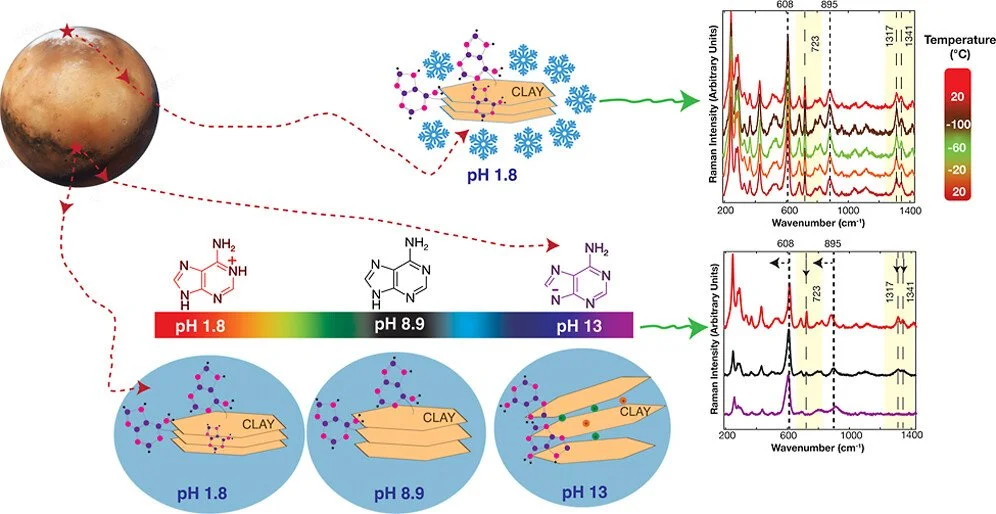
Conceptual illustration of adenine interacting with Fe-rich nontronite clay under extreme pH and temperature conditions. Image Credit: Singh and Yesilbas (2026) ACS Earth Space Chem, DOI: 10.1021/acsearthspacechem.5c00299.
Congratulations to our Carl-Trygger postdoc fellow Surendra and PI Merve on a new Mars paper!
We are excited to share our latest Mars paper published in ACS Earth and Space Chemistry, led by our Carl Trygger postdoc Surendra Vikram Singh and our PI Merve Yeşilbaş! 🌟
What if some of the harshest environments on Mars were actually the best places to preserve life’s molecular building blocks?
In our latest study, we investigated how adenine, a fundamental nitrogenous nucleobase in DNA and RNA, interacts with Fe-rich smectite clays across extreme pH conditions. We demonstrate that adenine adsorption is strongly pH-dependent, with enhanced retention under acidic and cold conditions.
This pH dependence is particularly significant in the context of Mars’ geochemical diversity. While phyllosilicate formation is commonly associated with neutral to mildly alkaline aqueous alteration during the Noachian period, several regions, especially from the Hesperian era, show evidence for transient or localized acidic environments. These conditions have been linked to volcanic outgassing, impact-induced hydrothermal activity, oxidation of sulfur-bearing minerals, and acid-fog weathering.
Our findings suggest that such acidic niches, although traditionally considered less favorable for habitability, may have played an important role in stabilizing and preserving molecular building blocks of life. These settings could therefore represent promising targets in the search for biosignatures on Mars today.
Big congratulations to Surendra and our PI on this cool paper! Way to go, Surendra!!🚀👨🚀